
North East hailed for ‘electrification success stories’ after regional visit by Electrify Britain
National campaign group Electrify Britain has praised glowing examples of the North East’s shift away from oil and gas and towards electric technology as “one of the most inspiring success stories anywhere in the UK”.
The group visited Lanchester Wines, Power Roll, Redhills and Ebac, in County Durham, and Humshaugh Village, in Northumberland, to learn more about innovations the Government could support across the board.

The fact-finding mission is hoped to show that the North East can lead the way in pursuing clean energy as quickly as possible.
The group’s Press and Parliamentary Affairs spokesperson, Ben Halfpenny, who led the North East leg of the Plug In, Pay Less tour, said: “Some amazing things are happening here in the North East.
“It was fantastic to speak to people who are bringing down bills with modern electric tech. I’m going to do everything I can to help bring these stories to people in Westminster and Whitehall.”
Backed by energy giants Octopus, E.On and EDF, Electrify Britain is pushing the UK government to support faster, fairer, and more ambitious electrification, and will highlight progress in the region.
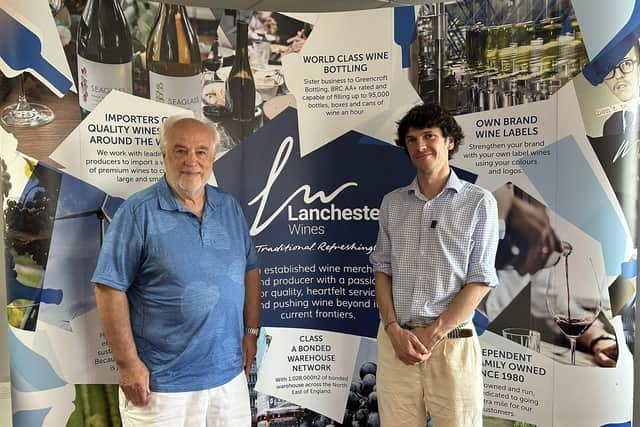
Ben visited Lanchester Wines, whose Greencroft Estate home near the village of Lanchester has become an advanced, inspiring, renewable-powered industrial site.
The company, founded by Tony and Veronica Cleary almost half a century ago, runs three wind turbines, extensive rooftop solar, and air-source heat pumps at its Greencroft Two bottling plant, which, uniquely for the time, also has insulated walls to significantly reduce heat loss.
Lanchester Wines’ new electric delivery trucks will pay for themselves in under two years because they’re powered by on-site-generated energy.
“Tony Cleary outlined a business vision based primarily on financial sense,” Ben said. “He saw that electrification and the greater energy security it provides was the right thing to do for the business, and we’re now standing here, under immense wind turbines, looking at a bottling plant powered by renewable energy, generating surplus electricity that can charge electric delivery trucks.
“Switching to electricity has provided significant savings. The whole approach encourages you to think about what the future of British industry could and hopefully will look like.”
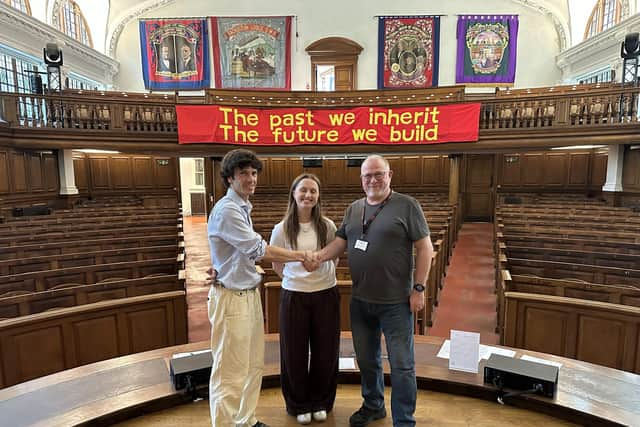
Earlier, Ben had been to Redhills, the home of the Durham Miners’ Association.
Once heated by coal and later left derelict, the Grade II listed building has been reborn as a community hub powered by geothermal energy drawn from the old mine workings beneath it.
“What the community has achieved here is extraordinary,” Ben said. “Not only has a building of immense cultural importance been saved, but it has been transformed into a modern community space that sets standards for the future.
“Meeting staff, speaking to the amazing volunteers, standing under the banners - you learn that this is an institution and community that wants to mark and celebrate its heritage by building something radical.
“The brilliant way this building is now heated in winter, and sits cool in summer, will sustain its place as a monument and hub of activity well into the future.”
He praised the engineering work that removed the entire hall floor, laid pipes into the ground, and restored the historic oak seating of the Pitman’s Parliament above a modern geothermal system.
“Places like this prove that old buildings, places of heritage, can be reconstructed and powered in modern, forward-looking ways.”
Ben also met companies at Aycliffe Business Park, where more than 100 firms have embraced solar, energy efficiency measures and electrification thanks to shared expertise.
“The collaboration we’re seeing here - the sharing of knowledge, the drive to be more efficient by supporting each other - is really impressive,” Ben said.
“Businesses aren’t operating in silos, or simply waiting for national policy. These companies are working together, cutting bills and proving that electrification is good business.”
He spoke to representatives of Stiller, BTS Fabrications and Ebac, discussing their electrification ambitions in the current business landscape.
Visiting Ebac’s shopfloor, he noted its huge homegrown potential to manufacture British-made heat pumps.
Ben also visited Power Roll, in Seaham, a pioneering company creating flexible solar modules that could revolutionise renewable energy and electrification in both the UK and abroad.
“Power Roll’s engineers are in the process of perfecting this potentially world-leading material. This form of solar can go where inflexible panels can’t. Once it comes to market, its effects could be dramatic in moving buildings off oil and gas and lowering bills.”
Ben’s final stop was Humshaugh, a Northumberland village aiming to become the county's first Net Zero community.
With solar panels spreading across rooftops, heat pumps being installed weekly and plans for a community solar farm with battery storage, the village showcases the grassroots spirit of electrification.
Ben said: “I was fortunate to meet residents determined to help make their village healthier and more self-sufficient.
“You see electric tech at the village hall, at the doctor’s surgery, at the school. Humshaugh is a beautiful village in a beautiful county. Getting off volatile oil and gas and onto electric tech is part of how villages like Humshaugh will thrive well into the future.”
Ben said Electrify Britain will use the North East visits to push for stronger national policy to help households, businesses, public services and community institutions off oil and gas and onto modern, cheaper-to-run electric tech.
“I learnt so much by meeting people across these visits.
“They showed me not only the amazing efforts and innovation already underway but how much potential there is.
“Electrification is saving money, powering businesses and creating jobs right across the North East.
“Our job now is to build political and public awareness of these fantastic initiatives, and help drive change that will benefit people across the North East and wider country.”