
Sunderland's claim to the invention of the stottie cake
When I was a lad, making one of my rare appearances at school, we were asked to write a poem about our favourite foods. There was a prize for the best ditty.
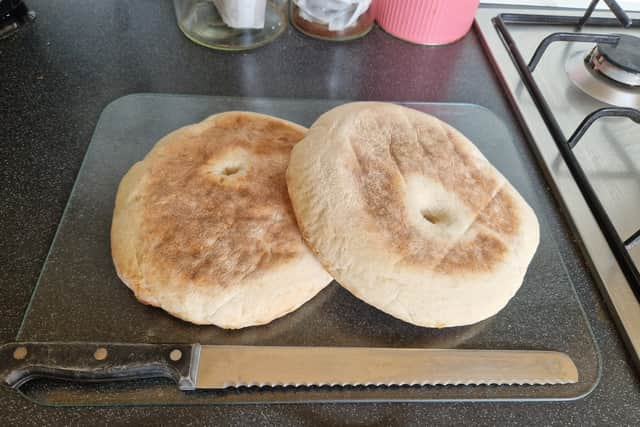

With customary minimal effort, I composed: "There are some foods for which we are potty; Like Star Bars, chips, or a cake which is stottie."
I didn't win.
However, the "poem" did instigate an historical debate on the origin of the stotty cake and its etymology. Why are they called stottie cakes?
This was the sort of thing we revelled in in class 3U. It was infinitely preferable to learning something that was actually useful.
My first port of enquiry was a mistake. My father. Adopting the air of an Oxbridge don attempting to recall an obscure Latin quotation, he asserted that the name was attributable to the high volume of stots required to create the delicacy.
My exhaustive enquiries ended there, as there was snooker on that night. I discovered the next day that none of my classmates had made any progress either; save for the same piffle from their own dads about "stottage levels", as well as some other claptrap about a baker called Sir Edgar Stott, etc.
There was nothing else for it except to wait patiently for someone to invent the internet. The internet, as you know, is simultaneously the biggest dispeller and creator of nonsense in all of human history. Yet it has helped. A little.
We don't even know if it's "stottie" or "stotty", although the overwhelming preference is for the former.
A website called Spruce Eats claims, without offering evidence: "The cake originated in the part of England just outside of Newcastle."
What part would that be? All most all of England is outside Newcastle.
It adds: "The word 'stottie' comes from the term 'to stott,' which in the local Geordie vernacular means 'to bounce.' The Geordie dialect has origins in the tongue spoken by the Anglo-Saxon settlers of England." But so do other dialects.
The assumption that stotties are a Geordie confection is not elaborated upon by Spruce Eats. Nor is "stott" a uniquely Tyneside verb; it's used in Sunderland among other places, including Scotland.
However, the etymology is probably correct, as due to it's robust texture the flat bread we love could be open to exaggerated claims of bouncing if it was to be "stotted" off the floor.
Another claim from the Geordie (again) Bakers website is: "The history of the stottie can be traced back to the working-class communities of the North East in the late 19th century.
"Miners and shipbuilders needed a hearty and portable meal that could withstand their demanding workdays.
"The stottie's preparation is a labor (sic) of love.
"It's said that the name 'stottie' comes from the Geordie (ahem) word 'stot,' meaning to bounce, reflecting the bread's unique texture."
So there seems to be consensus about the name, but no one can confirm where exactly it was invented.
Therefore, we can say without fear of any conclusive contradiction, that the stottie cake was created in Sunderland by a Mackem baker.
We can't prove that, but crucially can't be disproved either. We thereby plant the Wearside flag, as it were, in the stottie cake.