
How and why Burnmoor Cricket Club is looking forward to a bright future
Burnmoor Cricket Club is looking forward to a bright future, writes Graeme Anderson.
Burnmoor Cricket Club is looking forward to a bright future after installing solar panels that will save it thousands of pounds a year in energy bills.
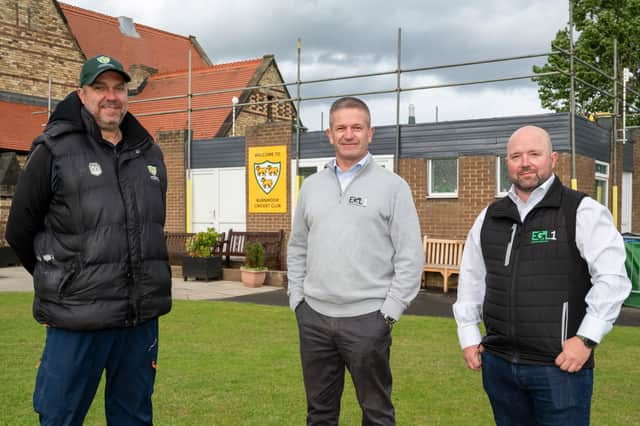

The money saved will support its cricket teams and other sports, as well as a host of community groups that meet there, with club committee member Martin Thursfield saying: “It will be transformative for a club like ours.”
The National Grid has paid for the £19,500 installation as part of community funding linked to its Eastern Green Link 1 (EGL1) project at Hawthorn, which will pipe renewable energy from wind farms off the coast of Scotland down to the North East.

Martin said: “We’re going to be eternally grateful for them supplying the funding which, from now on, will make us about £3,000 to £3,500 better off every year. And while that money saved is great for the first year, when you start throwing it forward and realise it’s maybe £7,000 overall by year two and £10,000 by year three, you can start to appreciate the impact it is going to have in the long term.
“It’s going to make a difference in all the little things that we can do and that can add up to a big difference. Simple things, like cricket balls, for example, which can be lost during matches, cost something like £25 a shot. We’ll comfortably be able to replace those and also update equipment and gear. We’ll have the funds to begin improving our facilities overall, which will make it a cleaner, tidier, more attractive destination and a better venue for our community groups. Hopefully, that will translate into extra footfall, especially as the village of Burnmoor is currently growing in size.”
Burnmoor’s historic clubhouse already welcomes around 30,000 visitors each year and hosts 19 regular community groups, making it a hub for sport and local activities, including rugby and tennis, as well as cricket. All will benefit in some form from the new renewable energy system, installed last month, which will reduce running costs and increase sustainability.
It’s great news for Burnmoor Cricket, founded in 1873 (the listed-building clubhouse is a few years older, having previously been a school), which will now be powered by 21st-century clean energy. The club joined the Durham Senior League in 1891, was a founding member of the Durham and District Senior League in 1902 and has a long record of competitive success.
Today it plays in the North East Premier League and the club hosts a first XI, second XI, a Sunday team and a midweek team as well as successfully running Under Under 7s, 9s, 11s, 13s, 15s, 17s and 19s sides, a Girls’ team and a Women’s team in development.
Martin hopes other cricket clubs will be able to take a leaf out of Burnmoor's book and safeguard their long-term future as a result. "There are plenty of clubhouses at cricket grounds around the region, and I'm sure the roofs of many of them would be ideal for solar. "If any other clubs out there are in a position to invest in panels or can get funding from somewhere, I'd encourage them to go for it," he said.
Burnmoor’s outstanding community ethos made it an ideal candidate for funding from the National Grid, which is keen for communities to enjoy the spin-off benefits of the £2.5 billion subsea electricity superhighway between Scotland and England, already under construction.
It will transport home-grown electricity for up to two million homes via 176 km of undersea cable, connecting south-east Scotland to north-east England at the former Hawthorn Pit in County Durham. Alongside delivering critical infrastructure, National Grid is supporting local communities in County Durham through funding initiatives designed to back projects that improve residents' lives.
Nik Davies, Eastern Green Link 1 project director, said: “Electricity supports every part of our day-to-day lives, and with demand set to double, we now need the grid to match.
“Eastern Green Link 1 will play a transformative role in delivering the modern electricity network needed for the future. "At the same time, it will deliver economic growth, jobs, and a supply chain boost in County Durham and beyond, and importantly, for the communities hosting this vital infrastructure, we are delighted to support projects that matter locally and deliver long-term social value.”