
Two strikers and a new role for Max Power: The intriguing tactical tweaks that Sunderland are set to implement against Bristol Rovers
Pre-season is a time for refining things – and Phil Parkinson has certainly done that at Sunderland.
While his 3-4-3 system served the Black Cats well for much of last season, there were times when they came frustrated and struggled to unpick stubborn defences.
But the elongated off-season period has given Parkinson and his staff a chance to refine things; to make the necessary adjustments to ensure this system is the one that will see Sunderland finally gain promotion.
So what are those tweaks, and how have they aided Sunderland already this season?


Using data from WyScout, we take a look:
ON THE FRONT FOOT
Sunderland have preferred a 3-4-3 shape in their time under Parkinson but, in their Carabao Cup tie against Hull City, some subtle tweaks to this system helped place the Black Cats on the front foot.
Their shape resembled more of a 3-4-1-2, with Chris Maguire playing behind Aiden O’Brien and Will Grigg. Max Power and George Dobson were also given licence to push on and join the attack - something we’ll discuss in more depth later.
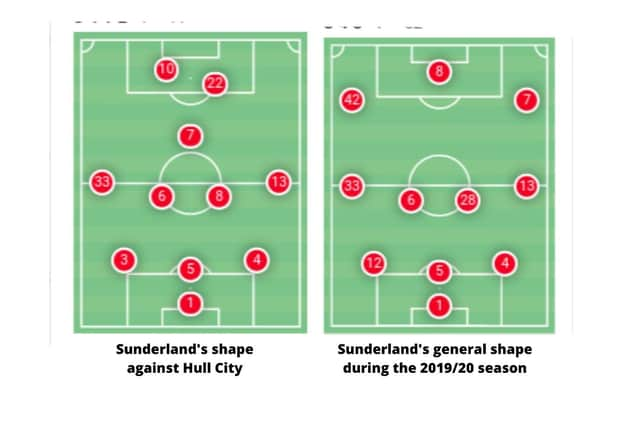
As shown in Diagram 1, O’Brien and Grigg played as an old-fashioned front two and this has some clear benefits for the Black Cats.
Simply put, it allows them to play on the front foot and aids the pressing game that the Wearsiders have tried to implement in recent months.
It allowed Sunderland to keep the ball in the final third for longer spells, with neither striker left isolated and unable to retain possession.
Data from WyScout also suggests that Parkinson’s side played at a higher tempo and ensured there was far less turn-over in possession which prevented Hull from mounting any quick counter-attacks.
Indeed, the Tigers launched only one counter-attack that ended in a shot during last weekend’s game, while on average Sunderland were hit by 2.42 counter-attacks per 90 minutes last season.
It would be no surprise to see Parkinson employ a similar approach against Bristol Rovers - and place his side firmly on the front foot.
PUSHING ON FROM MIDFIELD
One notable element of Sunderland’s set-up against Hull was the licence given to Max Power to push forward.
Parkinson stated this was a deliberate ploy as he felt that the midfielder could impact the game in the final third if given the opportunity.
And it seemed to yield the desired results.
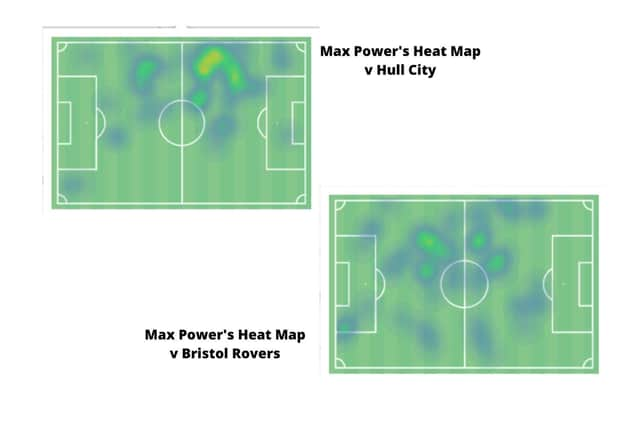
It’s interesting to compare Power’s heat map from the game with Hull City to the defeat at Bristol Rovers, in Sunderland’s last League One game of the 2019/20 season.
These are shown in Diagram 2 and show the increasing impact the 27-year-old is having on the club’s attacking outlook.
He has far more of an impact in the final third and is another willing body in the final third.
Power adopted a similar role against Aston Villa under-21s in midweek - although come the end of that fixture, practically everyone was playing in the visiting half such was the dominance that Sunderland were enjoying.
But against the Gas this weekend, it would be no surprise to see Power again pushing on into the final third and offering the Black Cats another option in and around the area.
We’ve seen in the past how deadly he can be from range, and adding more goals to his repertoire will be a major target for both player and manager this season.
THE STRETCHING STRIKER
One of the major conundrums facing Parkinson this weekend comes in the forward areas.
If, as assumed, it’s a 3-4-1-2 shape deployed by the Black Cats, then it is safe to assume that Chris Maguire will play in the role behind the strikers with Aiden O’Brien as one of the two players leading the line.
Who partners him remains unclear, though.
Despite his impressive cameo in midweek, Danny Graham is unlikely to be considered for a start at this point given the fragmented nature of his pre-season programme.
The choice therefore boils down to either Charlie Wyke or Will Grigg.
Wyke has been the preferred choice for much of Parkinson’s reign but the decision to start with Grigg against Hull last weekend spoke volumes about the work the former Wigan Athletic man has put in over recent months.
Parkinson has a clear role in mind for his strikers, which focuses as much on what they do off the ball than their performance on it.
He wants to see his strikers press high, winning back possession and putting the opposition defence under intense scrutiny.
And when Sunderland are in possession, forwards are encouraged to head out wide and stretch the opposition defence.
It’s in that second department where Grigg has made notable improvements, and perhaps edged ahead of Wyke in the pecking order.
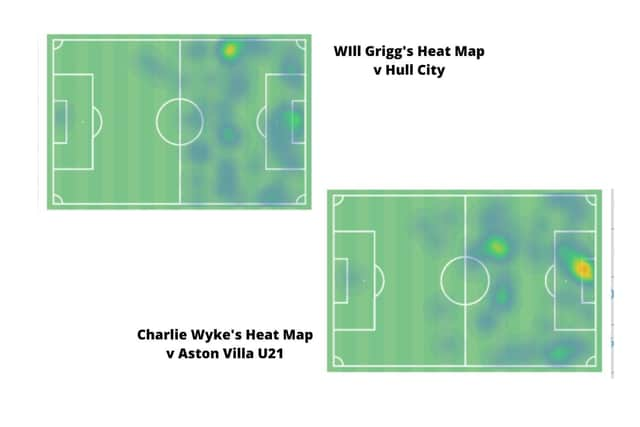
A look at Grigg’s heat map against Hull City (shown in Diagram 3) shows a large percentage of his touches came in the wide areas - showing his desire to run the channels and stretch the opposition backline, thus creating space for runners from midfield (such as Power, mentioned above) to move into.
In contrast, if we look at Wyke’s heat map from the midweek win over Aston Villa (also shown in Diagram 3) we see that the majority of his involvement comes in central areas.
For a striker, this is no bad thing - and is perhaps instinct, given you want your forward players in areas where they can find the net.
But for Parkinson, that work in the wide areas is a key consideration when making decisions - and Grigg has certainly impressed in that department.