
How the Sunderland Echo reported on the Shipyard Girls during World War Two
As Sunderland welcomes its latest public artwork, a striking sculpture in tribute to the women who worked in the shipyards during the war, the author of the best-selling book series which inspired the statue has been reflecting on this fascinating chapter of Wearside history.
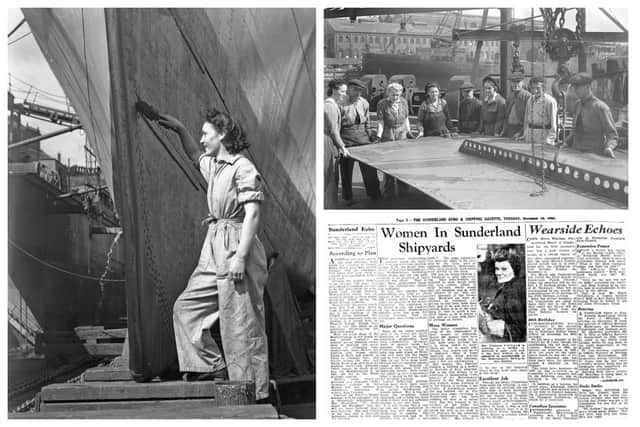

Whilst researching the best-selling saga series, The Shipyard Girls, author Nancy Revell plundered the Sunderland Echo archives for ‘everything and anything’ that happened between 1940 and 1945 in Sunderland.
While doing so, she stumbled across these articles and photographs about the real shipyard women workers.

Nancy, whose real name is Amanda Revell Walton, said: “I was over the moon as I’d really struggled to find anything that had been written about these forgotten women.”
One of the first articles Nancy came across was this one published in May 1942.
Nancy, who comes from a long line of shipyard workers, said: “Despite a reticence of employing women to do a ‘man’s job’, it was soon obvious there was no choice. Regardless of gender, the ships needed to be built – and fast.”
Women at work
The article reads:
Mr Bevin (Minister of Labour) said in the Commons to-day that the number of women employed in shipyards had more than trebled during the last 12 months.
Asked if he had considered the desirability of instituting lectures to prejudiced employers, Mr Bevin said: “I must confess that they have been slow in the utilization of women labour, but the thing is being speeded up very rapidly now.
Juggling work with the perils of war
Nancy, who was born and brought up in Sunderland, said: ‘Six months later in November 1942, it was clear that women were now most definitely an important part of the workforce in all the Wearside yards.”
An article from that period notes the importance of female labour:
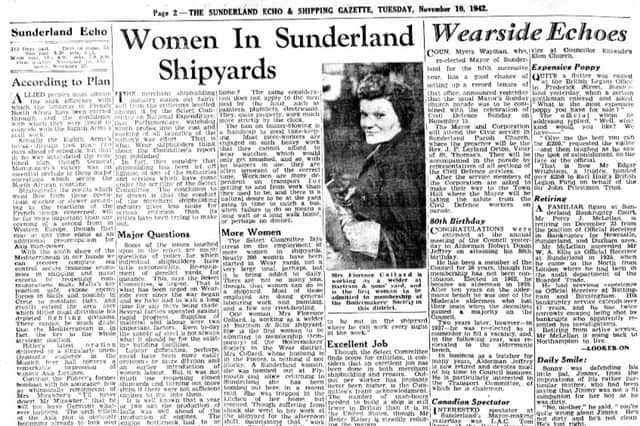
It reads: Labour difficulties, perhaps, could have been more easily overcome by … an earlier introduction of women labour…. The Select Committee lays stress on the employment of more women in shipyards.
Nearly 300 women have been, started in Wear yards, not a very large total, perhaps, but it is being added to daily. … One woman, Mrs Florence Collard, is working as a welder out in the shipyard at Bartram & Sons shipyard.
She is the first woman to be admitted to membership (temporary) of the Boilermakers’ Society in the Wear district.
Mrs Collard, whose husband is in the Forces is nothing if not plucky. A Sunderland woman she was bombed out at Plymouth and since returning to Sunderland she has been bombed out here in a recent raid.
She was trapped in the kitchen in her home but rescued. Though suffering from shock she went to her work at the shipyard for the afternoon shift maintaining that “work comes first”.’
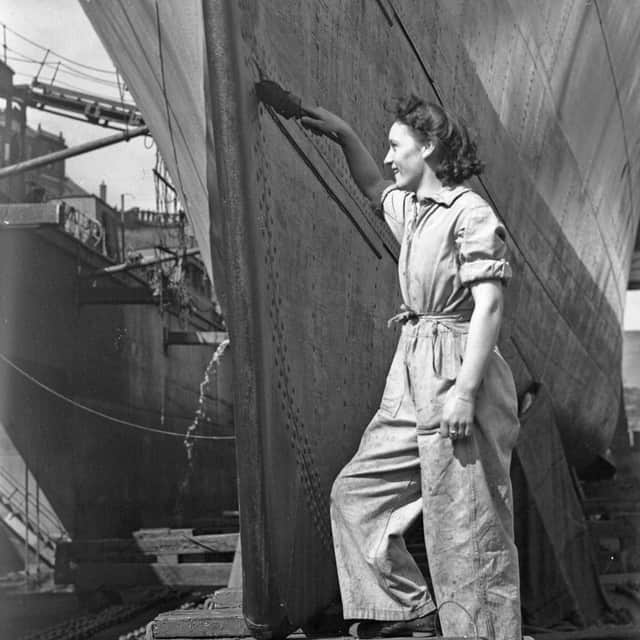
Wartime Echo photographers
After that article, during the course of the war, the Echo continued to feature the women shipyard workers doing different types of jobs.
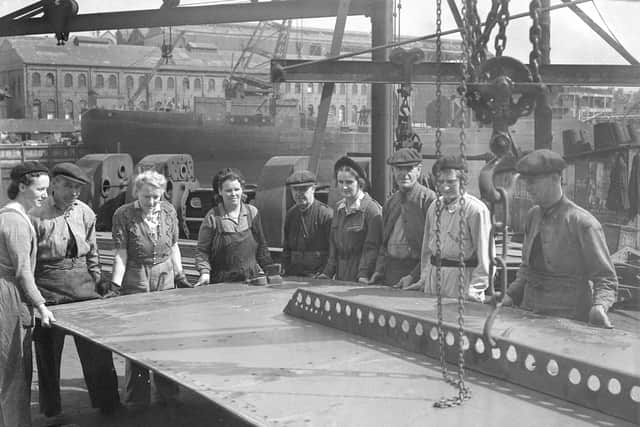
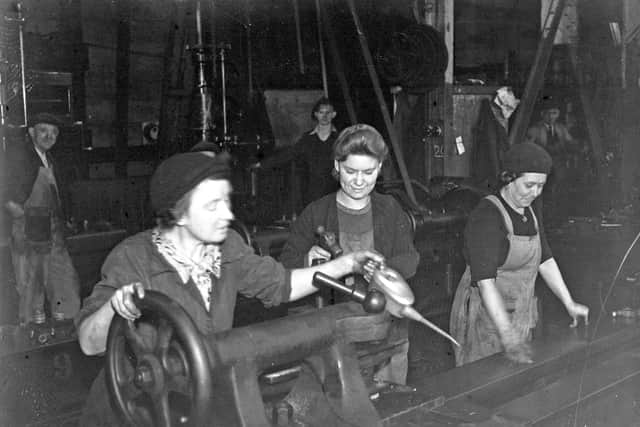
Downing tools
But, as the war in Europe came to an end, it would seem time was also called on the women who had spent the war years toiling in the town’s revered shipyards.
This article was published on 19 November 1945.
WOMEN’S JOBS ENDING IN THE SHIPYARDS: Sunderland it is computed that 6,000 women were employed in industry at the peak period of the war effort.
In recent weeks the numbers of women workers have been dwindling fast, especially in the shipbuilding and engineering industries. More than 700 women were employed in Wear shipyards and nearly a thousand in marine engineering shops.
Today not more than a hundred are left in the shipyards and there has been a corresponding reduction in the number in the engine shops.
At one time Doxford’s, for instance, had nearly 130 women working their shipyard. Now there are only 30.
The majority of the women were the wives of men serving in the Forces and they have no grumbling at giving up their jobs and going back to the full-time duty of looking after their homes now that, in most cases, their husbands have returned from the war.
The women workers in shipyards and engine shops, it is agreed, did useful work. Many were engaged merely in labouring work.
At keeping the place tidy, sweeping up the workshops and so on, they were, not surprisingly, better than the men.
Nancy said: “At the start of the war women were offered work in the shipyards, but given the label of ‘dilutees’ to imply that one woman could not offer the same skills as one man. The article goes on to show how wrong they were!
“The fewer numbers who got into semi-skilled or skilled jobs also did well and I have heard of machinists who have turned out far more work, of as good quality, than the men. Indeed, I have been told of one woman who produced as much work as six men in the same time.
“It sounds ‘tall’, but it was vouched for. And she was a married woman who after her day’s work in the factory went home and cleaned up the house and looked after her family. Her output surely puts the men in a poor light.
“But,” Nancy adds, “despite this, the article ends on the note that there is no future for women in the shipyards.”
The article continued: But there seems no future for women shipyards and engine shops. There was never any real enthusiasm about taking them on. A shipyard is not an ideal place for women to work in.
Their conduct and discipline, I gather, has been excellent —an example to many men. The unions had an agreement by which if women were taken on, they would be the first to be paid off when the pressure of work eased.
“Now that time has arrived the women are going, and without any complaints. The wives are ready to make wav for their husbands returning to their peacetime jobs.
A war of words in the Echo letters page
“I did have to chuckle, though,” Nancy says, “on coming across this war of words on the letters page a few months after VE day.”
The letter reads:
Dear Sir—The end of hostilities should bring a big change over from war-time jobs. Changes locally appear to be very slow, especially shipyards.
May I suggest immediate removal of women, to be replaced ex-Servicemen. This women labour, or the major part, has been a waste of money.
They could have been doing better service in their own homes... No wonder comments have been made in your columns of ten per cent more women in pubs drinking and puffing out smoke, depriving hardworking men of their pint of beer and cigarettes, when they have been getting money for nothing.
Nuts and Washers.
It was followed up the next week with this reply by an unnamed woman shipyard worker, referring to herself as Plater’s Helper, 6152.
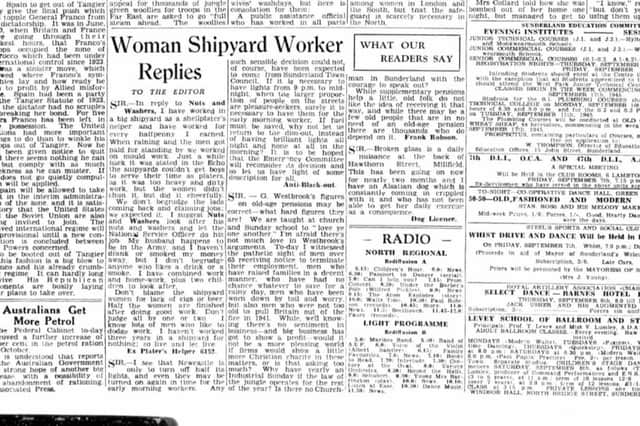
TO THE EDITOR SIR, —In reply to Nuts and Washers, I have worked in a big shipyard as a shell plater’s helper and have worked for every halfpenny I earned.
“When raining and the men got paid for standing by, we worked on mould work. Just a while back it was stated in the Echo the shipyards couldn’t get boys to serve their time as platers, as it was too heavy and dirty work, but the women didn’t shun it, but did it cheerfully.
We don’t begrudge the lads coming back and claiming jobs; we expected it. I suggest Nuts and Washers look after his nuts and washers and let the National Service Officer do his job.
My husband happens to be in the Army, and I haven’t drank or smoked my money away, but I don’t begrudge anyone who likes a drink or a smoke.
I have combined work and home-work, plus two children to look after. Don’t blame the shipyard women for lack of cigs or beer.
Half the women are finished after doing good work. Don’t judge all by one or two. I know lots of men who like to dodge work. I haven’t worked three years in a shipyard for nothing: so live and let live.
Plater’s Helper 6152