
Ofsted inspectors visited this Washington school and identified a key area in need of attention

Six of the seven assessed areas were judged to be the expected level
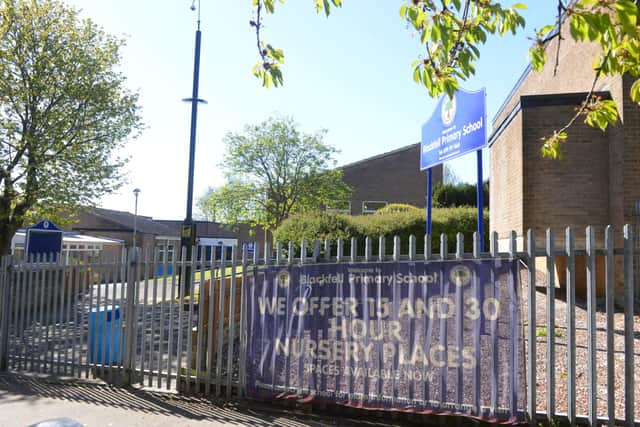
Ofsted inspectors visited Blackfell Primary School in Washington and deemed that one key area was in need of attention.

No one-word overall judgement is now given to schools with, instead, a traffic light report card given ranging from blue (exceptional), dark green (strong standard), light green (expected standard), amber (needs attention) to red which indicates urgent improvement is needed.
Inspectors visiting the school judged its Early Years provision as in need of attention.
The other key areas of achievement, attendance and behaviour, teaching and curriculum, personal development and well being, inclusion, and leadership and governance - were all judged by inspectors to be at the expected standard.
Commenting on the school’s Early Years provision, lead inspector Nicky White said: “The activities provided for pupils in Nursery and Reception sometimes limit their learning.
“While the environment is creative and inviting, children are not provided with enough opportunities to use their newly acquired reading, writing and mathematical knowledge independently.
“Staff's interactions typically do not support children well to acquire and embed new vocabulary securely. Leaders have recently taken action to improve the Early Years provision, but further work is required to ensure children are given appropriate challenge across the environment.”
The school’s wider teaching, curriculum and achievement was deemed to be at the expected level.
Ms White said: “The curriculum is appropriate and has been sequenced well so that pupils learn key knowledge and skills over time.
“The curriculum is typically taught well and, as a result, pupils remember what they have recently learned. Pupils enjoy lessons and particularly express a love of science, where they value the opportunity to complete a range of experiments.
“By the end of key stage 2 (Year 6), pupils achieve broadly in line with the national averages in reading, writing and mathematics. Disadvantaged pupils achieve well as a result of the school's work to remove barriers to their achievement.
“Pupils generally develop secure knowledge and are ready for the next stage of their education.”
Inspectors said attendance is in line with the national average and that pupils “typically” behave well and are “consistently polite and respectful”.
The report praised the school’s provision for children with special educational needs and disabilities (SEND).
Inspectors said: “Inclusion is prioritised by leaders, who are ambitious for all pupils with SEND. There are clear processes in place to help identify the needs of pupils with SEND and this has enabled staff to be more effective at meeting varied needs.
“Staff make appropriate adaptations that help children with SEND to learn the curriculum.
“Leaders make astute decisions on how the pupil premium funding is allocated to ensure pupils who are disadvantaged are supported well.”
The school was also commended for its successful approach to promoting positive mental health and “widening pupils’ experiences through the provision of a range of visits and after-school clubs”.
Inspectors also highlighted how “leaders and governors have strong oversight of the school and make decisions that act in the best interests of pupils”.
We asked for a comment from school leaders, but, as yet, have not received a response.