
We want to tackle the troubling gender disparity in heart health outcomes
“Save My Life, Not My Modesty” - that’s the message from female campaigners as they aim to tackle troubling gender disparities in heart health outcomes and emergency response.
Heart disease is the number one killer of women in the UK and kills more than twice as many women than breast cancer.
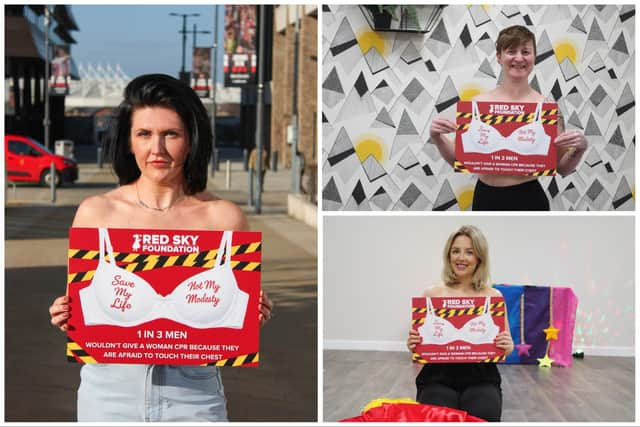

The “Save My Life, Not My Modesty” campaign aims to educate the public on life saving CPR and defibrillator use while highlighting systemic barriers that leave women at significantly greater risk during cardiac emergencies.
Despite advances in life saving techniques, research shows that women experiencing out of hospital cardiac arrest are less likely to receive bystander CPR than men.
This disparity is not rooted in biological differences in survival potential, but in widespread social hesitation about performing CPR on female bodies.
According to a survey by St John Ambulance in the UK, nearly one third of men and 13 % of women admitted they would be reluctant to perform CPR on a woman for fear of being accused of inappropriate touching, even though the technique is the same regardless of gender.
Only 68% of women were considered likely to receive CPR from bystanders, compared to 73% of men.
This hesitation is not just a matter of discomfort. It’s costing lives. Prior research indicates that more than 8,200 women in England and Wales could have survived a heart attack if they had received the same treatment as men.
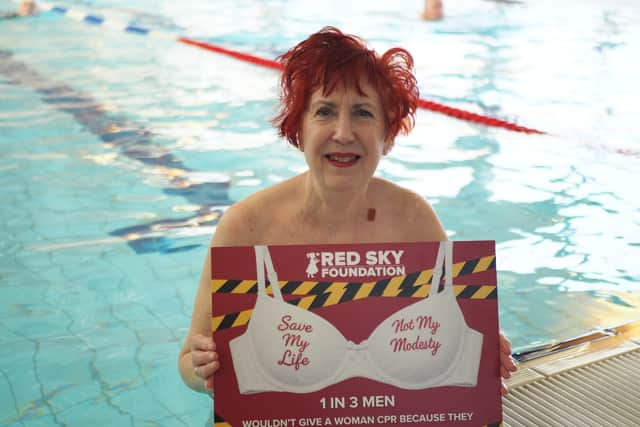
Globally, studies have documented that women are consistently less likely to receive bystander CPR and defibrillation than men, and their odds of survival are correspondingly lower.
Compounding the problem, the vast majority of CPR training mannequins, tools used to teach compressions and AED application, are designed with flat male presenting torsos.
Research has shown that when trainees practice on models that include female anatomical features, including breasts, they report nearly double the comfort level in performing CPR on female bodies, reducing bias and increasing confidence in real emergencies.
The campaign also draws attention to important safety issues around public access defibrillator use. For an AED to be effective, its pads must be in full contact with bare skin, a requirement that can be complicated by women’s clothing.
Women are 15% less likely to survive defibrillator use compared to men, largely due to hesitation or confusion around removing bras, especially those with underwire components that can interfere with pad placement or even cause burns when a shock is applied.
Red Sky Foundation emphasises that women are dying not because of inherent health differences but because bystanders are afraid, often due to concern about social repercussions or uncertainty about how to deliver lifesaving aid.
Research consistently shows that immediate CPR and AED use can more than double survival odds after cardiac arrest, yet hesitation persists, fuelled by misconceptions about anatomy and modesty.
Laura Kemp, Head of Operations at Red Sky Foundation, said: “I was shocked to learn that one in three men say they would rather stand and watch a woman die than step in to help, simply because they feel uncomfortable performing CPR. What was even more alarming was discovering that one in eight women also say they would feel uncomfortable performing CPR on another woman.
“We need to talk about this. People need to understand that in an emergency, a life is far more important than modesty. I would always choose to have my life saved rather than my modesty spared, and I have yet to meet a woman who feels any differently.”
The Foundation calls for widespread public CPR and AED education that specifically addresses gender bias and anatomical concerns, greater inclusion of female anatomy training mannequins to normalise lifesaving interventions on all bodies, and clear, accessible guidance on AED pad placement and rapid defibrillation, including practical instruction on removing clothing when necessary.
It also urges support for campaigns and initiatives that work to destigmatise emergency response on women.
You can learn CPR in just 10 minutes here, https://redskyfoundation.com/cpr/