
Meet the RNLI lifeguard helping to keep Sunderland's beaches safe this summer

After what seemed like a perpetual Autumn, summer has at last arrived and with the six weeks school holidays having begun, for many families a trip to the beach and a dip in the sea is a quintessential part of any British holiday.
However, while the temperatures on land may have at last warmed up, the North Sea remains a chilly 14 degrees Celsius and with the dangers of offshore winds, hidden rocks and rip currents, whilst a day at the beach is great fun, it can also be a dangerous place if it’s not respected.
Fortunately here in Sunderland we have a daily team of nine RNLI lifeguards on hand to enable us to enjoy the seaside safely. Across the summer months there are three lifeguards deployed at Roker beach, two at the Cats and Dogs Beach and four at Seaburn.
The team is led by senior lifeguard, Tom Hughes, who has been patrolling our beaches for the last five years.
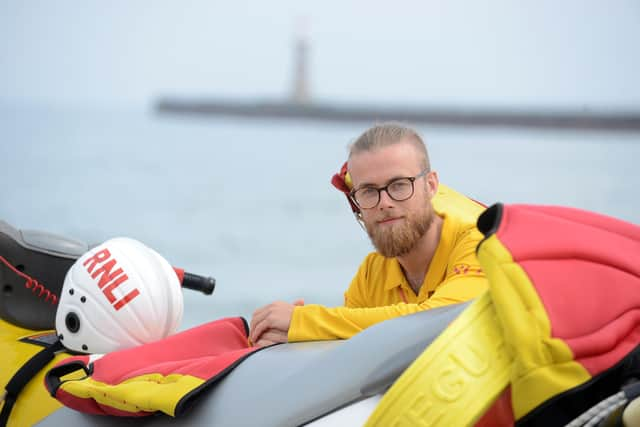

As I arrived at Roker Beach to meet Tom in the mid afternoon sun, the range of lifeguard equipment on display gave an insight into some of the potential perils beach goers can face if they don’t respect the environment they are in.
Tom, 23, said: “The device I have on my shoulder is a rescue tube, which we always have to carry on the beach. If a swimmer is in difficulty close to the shore we can swim out with this device and get them to hold onto it.
“You can actually support three people with this device. Once the casualty is stable we can swim them back to shore.”
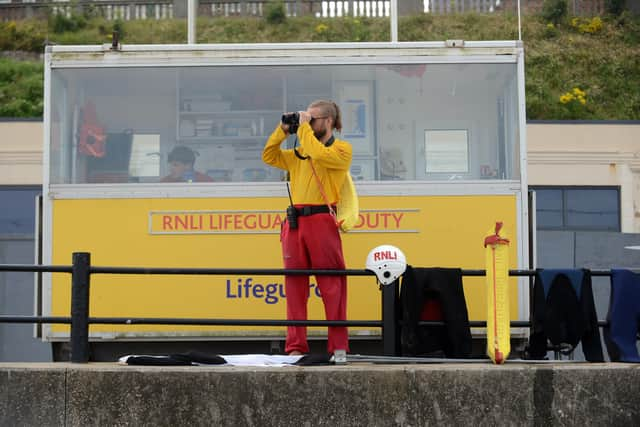
In rougher seas or with multiple casualties, Tom and his team would use a rescue board.
He added: “This can also be used if a casualty is further out to sea, up to around 200 metres offshore, depending on the conditions.
“We will swim out on the board and get the casualty on the front. It’s particularly useful if someone is unconscious in the water as we can flip the board upside down and then flip the casualty on top.
“If someone is further out, there are several casualties or there are choppy conditions, then we use the rescue watercraft which is very quick.
Fortunately Tom has not yet had to perform any rescues this school holidays, but as the busiest time of the year for beach goers, he has had to perform a number of potentially life saving rescues in the past.
Recalling one particular incident, Tom said: “Last school holidays I had to swim out and rescue one young man. There were very strong offshore winds blowing out to sea. He had kicked his football out to sea. It was drifting out and he decided to go in and swim after it.
“He was locked in on the ball and didn't realise how quickly he was being taken out to sea.
“He wasn’t a particularly strong swimmer and by the time he reached the ball he turned around and realised he was about 55 metres out to sea.
“I was out on patrol, had noticed what was happening and so had already set off on a rescue board.
“I could see he was beginning to struggle. Luckily I was able to get him on the board and bring him back to shore.”
Whilst it’s vital to have lifeguards such as Tom at the ready to rescue people from life-threatening situations, he sees the most important part of his role as stopping people from getting into trouble in the first place.
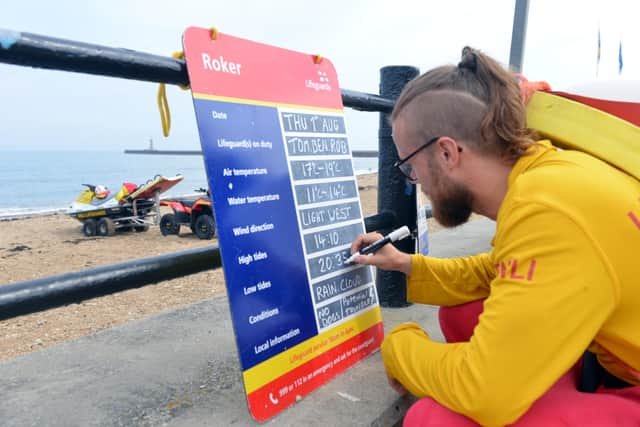
He said: “On the day to day operations of the beach, the name of the game is prevention. Each day we review the tide times and conditions to decide where it’s safe for people to swim.
“We also fill in a notice board each day which is positioned outside the Lifeguard Station. It tells people key information such as the sea and air temperatures, tide times, wind speed and direction, which are really important for people to know.
“The tide times are particularly important for people wanting to walk between Roker and Cats and Dogs Beach as it does become cut off by the tide.”
To qualify as a lifeguard, Tom and his colleagues had to undertake a National Beach Lifeguard Qualification.
He explained: “We also have to do a fitness test which the RNLI requires us to complete a 400 metre swim in seven-and-a-half minutes and a 200 metre beach run in 40 seconds.
“Once qualified we also do a lot of on the job training using the rescue boards, rescue vehicle and quad bike.
“We also have to do a casualty care course which is an advanced first aid qualification.”
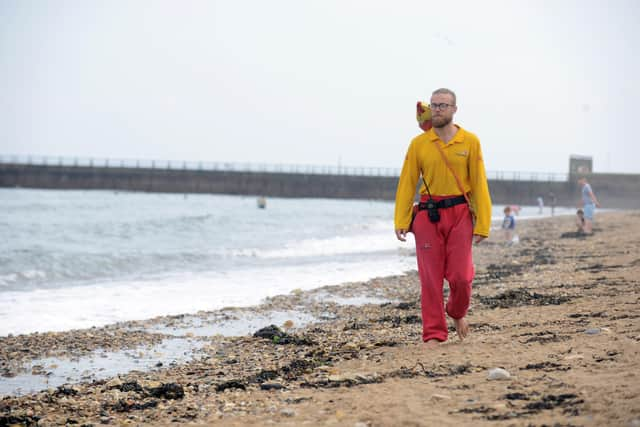
Tom’s dangers to look out for and top tips for staying safe
Lifeguarded beach
Tom said: “If you want to come down to the beach then my first piece of advice would be to choose a lifeguarded beach and you will know this because we will be flying red and yellow flags.”
Swim and paddle between the flags
He added: “We’ve looked at all the dangers in the water such as rip currents, rocks and big waves and assessed which is the safest part of the beach.
“If you want to go in the water then swim between the red and yellow flags.
Adopt the float to live position
Tom explained: “If you do get into trouble then adopt the float to live position which is on your back with nose and mouth above the water and arms and legs to the side, gently moving them to keep you afloat.
“Give yourself some time to catch your breath and then put your hand in the air and call for help.
Paddle boarding and inflatables
“I’ve had to deal with a number of situations with paddle boarders and inflatables being blown out to sea by strong offshore winds.
“When there are strong offshore winds we fly an orange windsock. If you see this flying then this is us advising not to take a paddle board out or to be on an inflatable.
Rip currents
Rip currents are created when the breaking waves which are returning to the sea are funnelled into one area creating a current of water being channelled back out to sea.
Tom said: “If you end up in a rip current it will take you straight out to sea. Your instinct is to try and swim against the current back to the shore, but you're not going to beat the strength of the current.
“You need to swim to the side, parallel to the shore, until hopefully you come out the current and can call for help.”
Don’t go in and attempt a rescue
Tom said: “If you do see someone in trouble, then the most important thing is not to go in after them. If you are on a lifeguarded beach then shout for the lifeguards and we will come and help.
“If you’re not on a lifeguarded beach then call 999 and ask for the Coastguard.”
The RNLI lifeguard teams are on the city’s beaches everyday from 10am to 6pm between May and September.