
I've overcome autism to get my PHD and I now want to inspire others to achieve their goals

“I was consistently bullied and excluded from normal social activity”
The words of scientist Daniel Parker after graduating with doctorate from the University of Sunderland.
He now wants to inspire other autistic children and young people to achieve their own goals and potential.
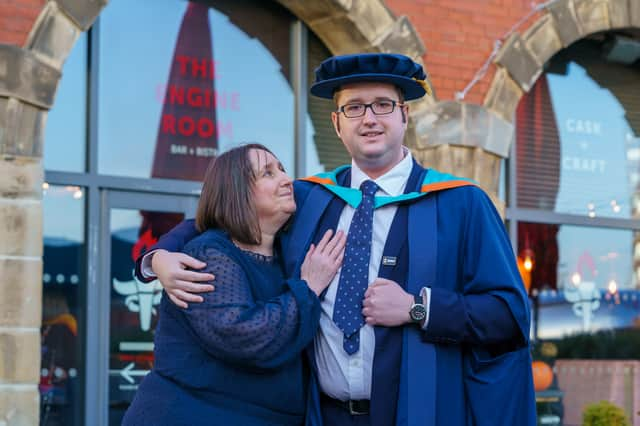

Daniel, 29, has recently completed his PHD in developing advanced chemical analysis for complex drug compounds.
At the age of 14 he was medically diagnosed with Asperger's Syndrome and recognised as being on the autistic spectrum.
After completing his PHD he said: “I was consistently bullied and excluded from normal social activity; thankfully everything changed for me once I was accepted into the University of Sunderland.
“The University was open, honest and accepting of my condition, and offered sincere assistance in the application processes and disabled student allowance guidance.
“The support has been unparalleled, from getting me through the first-month nerves of my bachelor’s degree, to helping transition to my PhD. Without the support of the University, I would not be even half the analytical scientist I am now, especially the support mentorship offered by the student support services.
“It feels validating to finally graduate with my PhD. It is proof of the skills I have developed, and that the work I have poured into developing novel high-performance liquid chromatography (HPLC) methods for difficult drug-related substances was worthy.”
Daniel’s mum Sharon, who attended his graduation ceremony at The Fire Station in January, said: “It was the proudest moment seeing Daniel receive his doctorate and walk across the stage. He has become the confident and happy man he was always meant to be.
“It has been a long road, but the success he has achieved, made possible through both his commitment and the University’s Disability Support team, is something that only the University of Sunderland could enable.
“I’m looking forward to seeing him live life instead of, as he told me when he was younger, 'only looking at life through a window, always separate, never a part of it'.”
Daniel is currently working at the University as a student demonstrator, assisting academic staff by guiding undergraduates through practical laboratory sessions, computer exercises, or field work.
In a message to others who may face barriers to achieving their dreams, Daniel said: “Your condition is not your rate-limiting step, it doesn’t determine your path. With time, patience and the right support you can achieve what you set out to do.”
Dr John Lough, who supervised Daniel on his PhD, said: “Over the last few years Daniel must have been the most knowledgeable research student in separation science in the entire UK.
“Through his strong commitment to his research programme and his dedication to his science, he has overcome daunting challenges such as giving a 35-minute oral presentation to an 80-strong audience of experts and peers at Burlington House, home of the Royal Society of Chemistry in London, presenting posters at international conferences and, of course, his PhD viva.
“I would also acknowledge the amazing support Daniel received from the various individuals involved in the University's wellbeing team and from his mentors. The University has a hard-earned reputation for student support. Long may it continue."