
Horrific - Watch as RAF WWII veteran recalls the horrors of war and the terrifying moments under Luftwaffe attack

“I flew 36 missions and every time I went up my overriding thought is will I come back, but we had a job to do to defeat the Nazis and it had to be done”.
The harrowing words of 102-year-old WWII RAF veteran Tom Davidson who spoke to the Echo about the horrors of war ahead of Remembrance Sunday.
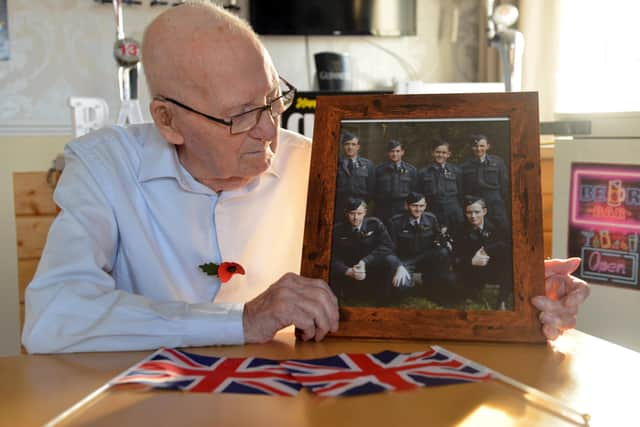

Tom, who now lives in Holly House Care Home in Washington, joined the RAF in 1943 where he saw active service as an engineer and co-pilot on a Halifax Bomber.
As an engineer at Rayrolle in Hebburn, Tom was in a protected profession and didn’t need to volunteer, but at the age of 18 he decided to follow in his brother Frank’s footsteps and travelled to Lord’s Cricket Ground in London and enrolled in the RAF.
Tom said: “In 1942 the Air Force had suffered such heavy losses that the Government opened up the opportunity for people in protected professions to join up.
“So many of my school pals had signed up and many had been killed, but I felt like I was on the side-lines and I wanted to do my bit to defeat the Nazis.”
After passing his training, Tom teamed up with his fellow RAF 466 crew members, pilot Pat Gillis, bomb aimer Lawrie Lovelock, navigator Ray Woods, wireless operator and air gunner Nev Adams, rear gunner Bill Allan and upper gunner Bluey Edwards.
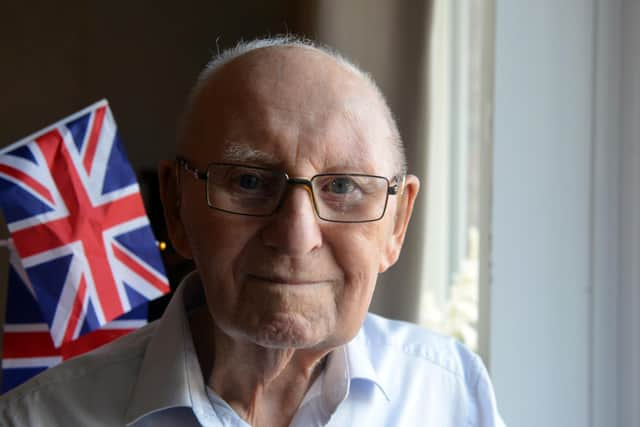
Recalling the “terrifying” experience of coming under attack from Luftwaffe fighter jets Tom explained: “We were sent on missions to destroy military targets including submarine pens, oil refineries, and chemical plants.
“I can’t recall what our target was on this particular mission, but I remember the terrifying moment it came across the radio that we were under attack from German fighter planes.
“They were so much faster than a Halifax bomber and their gun range was 1,200 metres compared to our guns which had a 400 metre range.
“The only way to escape was for out pilot Pat to put us into a corkscrew where you go into a spinning nose dive and drop about 500 metres.
“We also had to open the hatch in case we got badly hit and had to bail out. We did suffer damage from the gunfire, but fortunately it didn’t hit any of the controls. If any of the control system was taken out then that would have been it.”

Unfortunately, not all crews who flew alongside Tom were so fortunate.
He added: “You would see other planes getting hit and bursting into flames. You would then see some of the crew jumping out, sometimes in flames - it was horrific.
“I used have terrible nightmares about it. Being set on fire was always my biggest fear.”
Tom recalled three occasions where he “thought we were going to have to bail”, but fortunately managed to evade any fatal blows to their aircraft, although they did once have to fly home from Germany on just three of their four engines.
Tom said: “Every time we encountered enemy aircraft fire Pat would tell us to have our parachutes to hand in case we had to bail out. Despite this, we knew what cord to pull but we had never done any training to jump and parachute out of an aircraft.
“If we’d ever had to do it for real then it would have been the first time.”
Before being stationed at RAF Driffield Tom had wed his childhood sweetheart Mary who lived in Gateshead, and every time he boarded his Halifax Bomber Tom would always go through the same ritual - just in case he didn’t return.
He said: “I lost around 50% of my colleagues, and so I always knew there was a good chance I might not return. I had a photograph of Mary on my locker and before I went on each mission I would pick it up and look at Mary, before giving her a kiss.
“I would then turn it towards the doorway. It was my way of saying goodbye, in case I didn’t return.”
Fortunately for Tom he survived his 36 missions with RAF squadron 466 and at the end of the war in 1945 he returned back to the North East to be reunited with Mary, where they enjoyed over 70 years of happy marriage together.
He said: “Mary didn’t know I was coming, there was no such thing as emails or mobile phones back then. I remember walking down Dean Street and knocking on the door.
“When Mary opened it, we embraced and I just remember thinking I’m still here, I’m alive.
“Mary said she always knew I would survive - but I wasn’t so sure.”
Reflecting back on what is now the 80th anniversary of Victory in Europe which was followed by victory in Japan, Tom said: “For years I felt guilt - guilt that I had survived when many of my friends and comrades didn’t.
“It was horrific. War is so futile and unnecessary. The best way to settle any dispute is like this, sat around a table.”