
How to turn your Krakow holiday into a powerful history lesson at Auschwitz

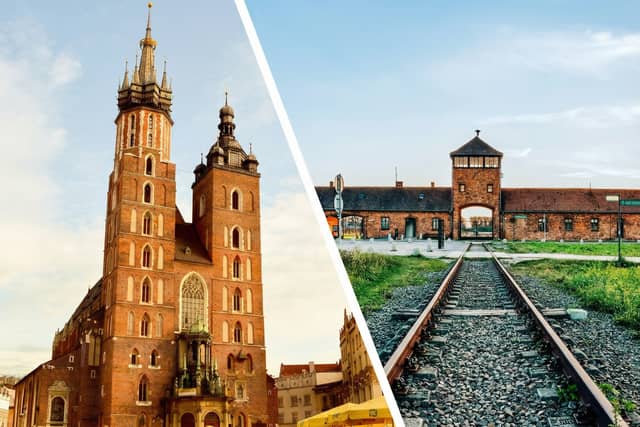

Plan it right, and you leave Poland with a deeper understanding of history, its victims, and your own responsibility as a witness.
Krakow is one of Europe's most beautiful cities - and it sits just 70 km from Auschwitz-Birkenau, the largest Nazi concentration and extermination camp in history. Combining a Krakow city break with a visit to this memorial site transforms a holiday into something far more meaningful. Plan it right, and you leave Poland with a deeper understanding of history, its victims, and your own responsibility as a witness.
Why visiting Auschwitz from Krakow makes sense
Krakow served as the administrative capital of Nazi-occupied Polish territory during World War II, making it deeply connected to the events at Auschwitz. The distance is manageable - roughly 70 km west of Krakow - and transport links are well-established. More importantly, Krakow holds Jewish heritage sites, wartime museums, and rich memory culture that give your Auschwitz visit crucial context before and after you go.
Visiting Auschwitz is not about dark tourism. It is about bearing witness - acknowledging what happened, honoring the victims, and ensuring the lessons of history stay alive. That moral responsibility is something every traveler can carry.
Planning your visit: logistics and timing
Getting the logistics right makes a real difference when visiting a site this significant. Whether you travel independently or join a guided tour, prepare everything in advance to focus fully on the experience itself.
If getting there from Krakow, you have several practical options:
Organized tours: These are the most popular choice. Operators handle transport and typically include a licensed guide. KrakowDirect offers professionally organized Auschwitz tours departing from Krakow, making the whole process straightforward for first-time visitors.
Public bus: Direct PKS buses run from Krakow's main bus station to Oświęcim, the town where Auschwitz is located. The journey takes around 1.5 hours.
Train: Trains run from Krakow Główny to Oświęcim, taking approximately 1.5–2 hours depending on connections.
Private car: Ideal if you want full flexibility over timing.
How long should you spend there?
We recommend spending a full day there. The memorial covers two separate areas - Auschwitz I and Auschwitz II-Birkenau - and rushing through either does a disservice to both the history and yourself. Most organized tours allocate 5–6 hours on-site.
Visit early in the morning when crowds are smaller and the atmosphere more contemplative. Spring and autumn offer comfortable temperatures and a calmer pace. Summer brings the largest visitor numbers, so book well in advance.
Timed entry tickets are required during peak hours (10:00–15:00). Book directly through the official Auschwitz-Birkenau Memorial and Museum website. Guided tours through reputable operators typically include ticket reservations as part of the package.
Preparing yourself emotionally and mentally
No amount of reading fully prepares you for walking through Auschwitz - but preparation still matters. Before you go, read survivor accounts such as Night by Elie Wiesel or Man's Search for Meaning by Viktor Frankl. Watching documentaries like Shoah (Claude Lanzmann, 1985) also helps you build historical context.
Set realistic expectations. This will be emotionally intense. Give yourself permission to take breaks and process what you see at your own pace. If you plan to bring children, the museum recommends the site for ages 14 and above.
Navigating the Memorial: Auschwitz I and Auschwitz II-Birkenau
The memorial consists of two distinct areas, each telling a different part of the story. Walk through both - together, they form a complete picture of what happened here.
Auschwitz I - The Original Camp
Auschwitz I began in 1940 as a prison for Polish political prisoners and today functions as the primary museum space. Key things to experience are the "Arbeit Macht Frei" gate - the infamous iron entrance, a symbol of Nazi deception, Block 11 - the punishment block where prisoners faced torture and execution, the permanent exhibitions - covering deportations, living conditions, and the mechanisms of mass murder and personal artifacts. These artifacts carry the greatest power. They turn statistics into individuals and make the abstract devastatingly concrete.
Auschwitz II-Birkenau - The Scale of Extermination
Birkenau lies about 3 km from Auschwitz I and stretches across 175 hectares. This is where systematic mass murder took place, primarily targeting Jewish people from across occupied Europe.
Do not skip Birkenau. The preserved ruins of the gas chambers, the rows of barracks stretching to the horizon, and the railway track leading directly to the selection platform communicate something photographs simply cannot. Walk to the International Monument to the Victims of Fascism and Genocide at the far end of the site and stand there quietly. This is one of the most important moments of the entire visit.
Enriching the Experience Back in Krakow
The history lesson does not end when you leave Auschwitz. Krakow offers layers of related history worth exploring before or after your visit to deepen your understanding of what this region lived through.
Kazimierz, Podgórze, and the Ghetto Heritage: The Kazimierz district served as Krakow's Jewish quarter for over 500 years before the war. Today, synagogues, cultural centers, and bookshops sit alongside cafés and galleries - walking through it helps you grasp what the world lost. Across the Vistula, the Podgórze district is where the Nazis established the Krakow Ghetto in 1941. Visit Ghetto Heroes Square, marked by 70 empty metal chairs - one for every thousand Jews the Nazis deported from the ghetto. Nearby, the Pharmacy Under the Eagle is a small but powerful museum inside the actual pharmacy Tadeusz Pankiewicz ran during the occupation.
Schindler's Factory Museum: The Oskar Schindler Factory Museum is a must-visit. Its permanent exhibition - Kraków under Nazi Occupation 1939–1945 - documents the full experience of Krakow's residents under occupation, far beyond the Schindler story alone. It ranks among the finest World War II museums in Europe.
Carrying the Lessons Forward
Standing inside Auschwitz changes something in you. The physical presence - the scale, the silence, the smell of old wood and stone - embeds the memory in a way no book or film can replicate.
That firsthand witness carries responsibility. Support the Auschwitz-Birkenau Memorial Foundation, which funds the preservation of the site and its thousands of artifacts. Share your experience thoughtfully, with the aim of educating rather than shocking. Apply what you learn to the present - the history of the Holocaust connects directly to contemporary discussions about human rights, the rise of extremism, and the protection of minorities.
Not every traveler feels drawn to difficult history. But an Auschwitz visit from Krakow is within easy reach, the visitor infrastructure is excellent, and the experience offers something no Old Town sightseeing tour can - a direct, unmediated encounter with one of the most important events in modern history. The victims of Auschwitz-Birkenau deserve witnesses. Go and be one.