
Sunderland woman paralysed in skiing accident backs campaign for better NHS bowel care

“Paralysed bowel care should not be 'a nice to have' in the NHS - it is an essential care requirement”
The words of a leading nurse Carol Adcock from the charity Spinal Injuries Association.
Val Milnes from Houghton-le-Spring, who was left paralysed from the chest down with no bladder or bowel function, is backing the charity’s campaign for better bowel care for NHS patients.
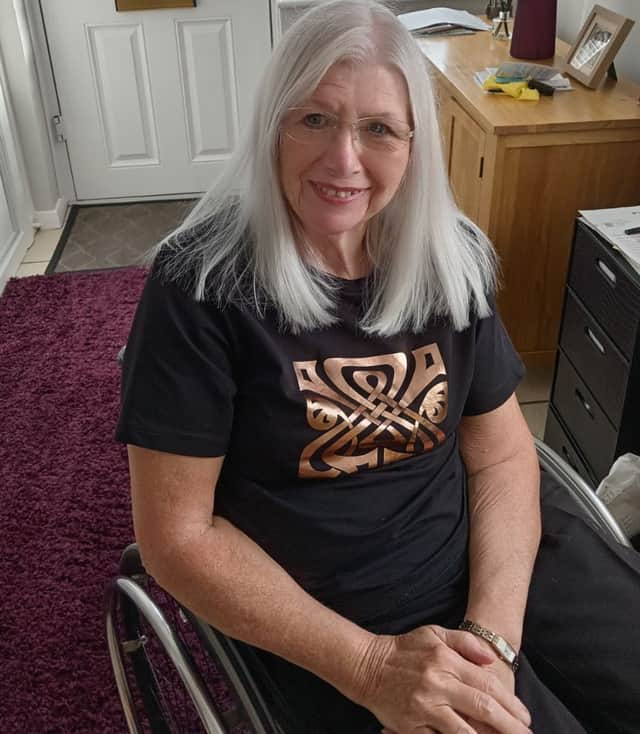

Drawing on her own struggles with bowel care in hospitals, Val has teamed up with the Spinal Injuries Association to raise awareness of the need for better paralysed bowel care in the NHS, including “better staff training”.
Val sustained a spinal cord injury in 1996 when skiing in France with friends.
After three weeks in a French hospital, three weeks in Newcastle, and 10 months in a spinal rehabilitation facility, during which time she developed a blood clot which she was told she had a 10% chance of surviving, Val was able to return home and begin rebuilding her life.
Val was paralysed from the chest down and lost all bladder and bowel function, and adapting to life at home was difficult.
She said, “At the time, I was pretty much suicidal because I didn’t want to live alone and not be able to do anything by myself.”
While no official figures on the prevalence of paralysed bowels exist, the charity estimates that over 457,000 people in the UK with neurological conditions, including spinal cord injuries, multiple sclerosis, and Parkinson’s disease, experience the symptoms of paralysed bowels, which may present as incontinence or retention.
As well as being essential for patient dignity, proper bowel care is also needed for patient safety and medical wellbeing.
The issue of care for patients with a paralysed bowel once again came to the fore in 2022 when Val was admitted to hospital for surgery.
Val said she “received no bowel care for two weeks”, despite repeatedly explaining to staff that she was at risk of autonomic dysreflexia - a potentially fatal condition triggered by a a full bowel or bladder.
The condition affects people with high level spinal cord injuries and is characterised by dangerously high blood pressure that can be fatal if not properly managed.
When she returned home, Val was “forced to stay in bed for three months due to issues with her bowel”.
After returning to hospital for x-rays, it was revealed that Val had an impacted bowel. She remained in hospital for two weeks, but as soon as she returned home, the problems started again.
Val said: “I didn’t think I was ever going to get better and I was going to be confined to bed for the foreseeable future.”
It was only when she went to the spinal unit at James Cook University Hospital in Middlesbrough that Val eventually received the appropriate treatment.
Spinal Injuries Association's SCI Specialist Nurse Lead, Carol Adcock, said, "Paralysed bowel care should not be 'a nice to have' in the NHS. It is an essential care requirement in both acute and community healthcare settings.
“Providing this care will prevent avoidable complications and costly hospital admissions. It is much cheaper, and humane, to provide structured, appropriate timely interventions than treat unmanaged paralysed bowel."
In 2025, a collaboration of disability charities - Spinal Injuries Association, Aspire, Cauda Equina Spinal Cord Injury (CESCI), Spinal Research, Regain Sports, Stoke Mandeville Spinal Research, and spina bifida charity Shine - launched the first National Paralysed Bowel Care Awareness Day on February 10 each year.
The day is used to raise awareness of the condition and to advocate for better training for NHS staff.
We contacted the NHS about Val and the Spinal Injuries Association’s better bowel care campaign.
A spokesperson for NHS England North East and Yorkshire region said: "We appreciate the significance of bowel care for patients with spinal cord injuries. This is recognised in our national service specification, which sets out how these essential services are delivered in our specialised centres such as James Cook Spinal Unit in Middlesbrough.
“We remain supportive of the Spinal Injuries Association in their ongoing work to raise awareness around these key health concerns."
Despite her life-changing injury, Val has gone on to lead a fruitful and successful life. Over time, Val began to adjust and rebuilt a successful career in business while also raising her then-11-year-old son as a single mother.