
Nearly one in three adults in Sunderland believed to be clinically obese according to latest figures



Nearly one in three adults in Sunderland are classed as clinically obese, putting them at increased risk of heart disease, type 2 diabetes and some cancers.
The latest data (2023/24) provided by the Office for Health Improvement & Disparities (OHID), using data from the Sport England Active Lives Adult Survey, showed Sunderland has an estimated 32.8% of adults classed as clinically obese with a body mass index (BMI) in excess of 30%.

This latest figure is up from 30.4% in 2022/23 and 29.0% in 2018/19.
Responding to the figures, Sunderland City Council’s Deputy Leader and Cabinet Member for Health, Wellbeing and Safer Communities, Councillor Kelly Chequer said: “Factors which contribute to weight gain are complex. Through our Healthy City Plan we are continuing to work on initiatives such as improving access to healthy food and helping create places that promote physical activity.
“This is as well as working with partners on continuing established programmes which educate and offer support on healthy eating, activity and nutrition.”
The most recent figures highlight how obesity is a growing problem not just in Sunderland, but across the whole region with the 10 local authorities with the highest obesity rates located either in the North East (3), Yorkshire or the Midlands.
Hartlepool has the second highest national rate and the highest regional rate with 37.9% of the population estimated to be obese.
Gateshead has an estimated obesity rate of 37.2%, Stockton-on-Tees 36.4%, Middlesbrough 35.3%, Durham 34.4% and South Tyneside 31.1%.
Two of the lowest rates in the North East are in Northumberland at 30.7% and Newcastle at 28.2% - both still significantly higher than Camden in London which has an obesity rate of just 11%.
The data reveals a north south split with nine of the 10 areas with the lowest obesity estimates in southern England, with the three lowest areas all in London: Islington (13.0%), Hammersmith & Fulham (12.1%) and Camden (11.0%).
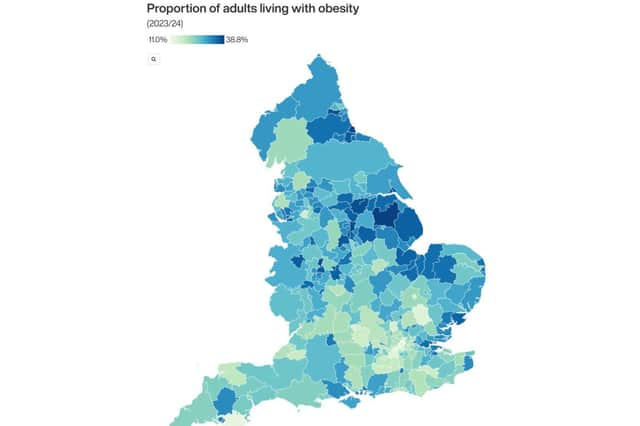
The highest obesity rate in England is in West Lindsey in the East Midlands where 38.8% of the population are believed to be obese.
Responding to the figures, NHS England national medical director Professor Sir Stephen Powis said: “Obesity remains one of the biggest public health issues we face as a society, and these figures show a small but concerning rise in the number of overweight and obese people.
“It is crucial we reverse decades of rising obesity rates and the associated cost to the health service, and those who needs support can access help through the NHS weight management programme via their GP.”
The prevalence of obesity is highest among those living in the most deprived areas of England, at 37.4% of adults in 2023/24, and lowest in those living in the least deprived areas (19.8%).
A Department of Health & Social Care spokesperson said: “This government has already taken action to tackle the obesity crisis by stopping junk food ads being targeted at children across TV and online, which will reduce the number of people living with obesity by 20,000 and deliver health benefits to the economy worth £2 billion.
“We’ve also given local authorities stronger powers to block applications for new takeaways near schools and we are commissioning research to improve the evidence on the health impacts of ultra processed foods.
“Through our Plan for Change, we will shift the focus from sickness to prevention, reducing the burden of obesity on public services and the NHS.”
Advice on leading a healthier lifestyle can be found on Sunderland’s Links for Life website.