
'My heart stopped - it was either a warning, or a second chance' - man thanks ambulance crew who saved his life

A man who survived a cardiac arrest has thanked the emergency crew who saved his life.
Graham Avery, 60, from Houghton, began feeling unwell one day in November 2024.
The dad-of-two became breathless, his legs felt heavy, and he had a pain down his left arm.
His wife Maria became concerned and sought help, with the North East Ambulance Service scrambled to the scene with newly qualified paramedic Hayley Francis and her crewmate, Graham Stones, on board.
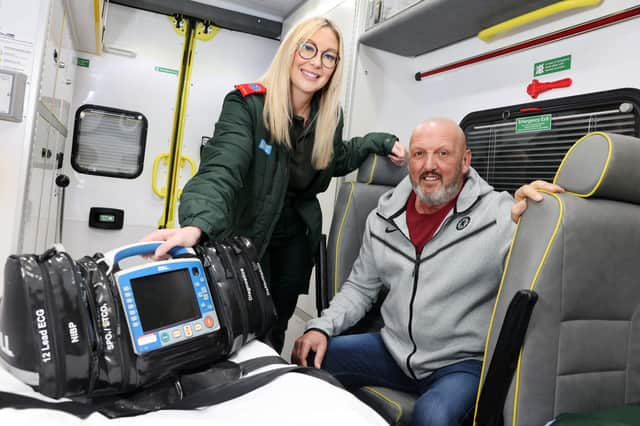

Graham, deteriorated and he went into cardiac arrest just as the ambulance arrived.
Graham had experienced what is known as an out-of-hospital cardiac arrest (OHCA), of which, less than one in 10 people in the UK survive.
Paramedic Hayley, who joined the service in 2023, recalls the moment they arrived.
“When arriving on scene I remember being greeted by Marie at the front door who showed us to Graham,” she said.
“I quickly realised that he was going into cardiac arrest in front of me and needed immediate interventions.
“When we go to a cardiac arrest call, we work tirelessly to give the patient the best possible outcome.”
A cardiac arrest happens when the heart suddenly stops pumping, which prevents blood from flowing to the brain and other vital organs, depriving them of oxygen.
This is different from a heart attack, although a heart attack can lead to a cardiac arrest.
Hayley began CPR (cardiopulmonary resuscitation) whilst her crew mate applied the defibrillator.
Once the pads were applied, Hayley continued the chest compressions until Graham’s heartbeat was in a shockable rhythm.
One shock was delivered to Graham which thankfully brought him around.
The control centre was informed of an out-of-hospital cardiac arrest (OHCA) and further resources were dispatched.
After his terrifying experience, Graham was taken to the Freeman Hospital in Newcastle where a stent was fitted.
“This was either a warning or a second chance. Whatever it is, I will grasp it with both hands. I always thought I was invincible but none of us are,” said Graham.
“I just wanted to meet the crew in person and say thank you – it's the least I could do.”
Hayley added: “We don’t always find out the outcome of the patient and that’s why a reunion like this is so special to us.”
A cardiac arrest can strike anybody at any time and every minute without CPR and defibrillation reduces the chance of survival by 10%.
Chest compressions provided during CPR pump blood around the body to keep someone alive until the ambulance crew arrives.
Without immediate treatment with CPR and a defibrillator, if there is one nearby, the person’s chance of survival reduces every minute.
It only takes a few minutes to learn CPR. To find out more, visit https://www.neas.nhs.uk/first-aid-community/emergency-advice/learning-cpr