
Great grandad, 88, thanked for 15 years of clinical trials at Sunderland Eye Infirmary
Sunderland Eye Infirmary has thanked its longest-serving research patient for his help in shaping services.


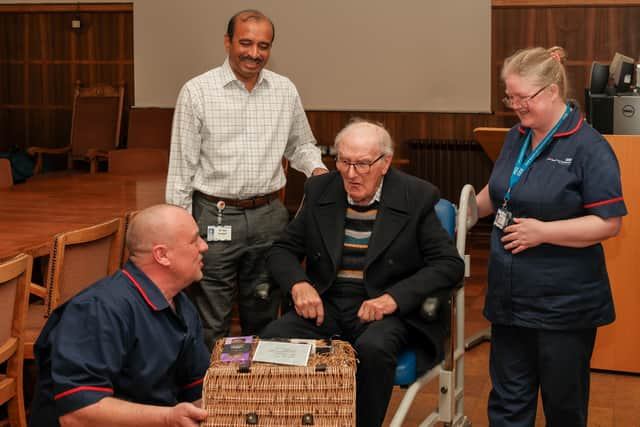
Charles Smith, 88, has taken part in a series of trials around age-related macular degeneration (AMD) during the last 15 years through Sunderland Eye Infirmary and has also helped shape its service by offering his views.
He backed the Research Team at Sunderland and South Tyneside NHS Foundation Trust as it joined in studies which look to improve the treatment of eye conditions.
It is thought he is the longest serving patient of its ophthalmology studies.
The hospital has one of the largest Macular Degeneration services in the country, with 23,000 intravitreal injections carried out each year at its site or satellite clinic at Durham Treatment Centre (DTC).
It is also one of the most research-active Ophthalmology units in the country, with 18 active trials live at this time. It is the only location in the North East which is taking part in gene therapy in its specialist area.
Trials are advertised to patients at the hospital, while team members can also refer them if they feel appropriate so they can find out more. There is also a database of people who have asked to support the studies, so they can be contacted if one comes up and is looking into the condition they are being treated for.
Charles, 88, who was born and raised in Roker, but now lives in Lanchester in County Durham, has wet age-related macular degeneration in his left eye and dry age-related macular degeneration in his right.
Alongside his wife Nancy, 81, the couple were presented with a Marks and Spencer hamper – including a bottle of Merlot in recognition of the first interventional trials he signed up to in 2010 which was called Merlot.
Charles, a former Woolworths manager, said: “I felt as though I owed something and wanted to be useful and it was a way to say thank you for what the hospital has done for me.
“In fact, it became a bit of a habit and I would come every so many weeks, and would always look forward to it and to meeting the staff.
“I’m a bit surprised by the gift, but it is very kind.”
Steve Dodds, research nurse at the hospital, said: “Charles has always been very keen to get involved and we think he must be out longest serving research patient of ophthalmology.
“Our patient population is an aging one and that’s what our research is often looking to help, so to have someone as long term as he has been and to have him not involved in just one study but two, has been such a help.”
New Eye Hospital

Work is under way to build a new Eye Hospital in Sunderland city centre as part of the Riverside Sunderland development site on land where the Vaux Brewery once stood.
The £48m development is fast rising into the skyline ahead of its opening in 2026.
The new hospital will house the region’s nationally-renowned Cataract Treatment Centre (CTC), a 24/7 Eye Emergency Department and, for the first time, have a Day of Surgery Admissions (DOSA) unit.
There will also be dedicated facilities for children who will have their own waiting and recovery area.
The new Eye Hospital, which replaces the Eye Infirmary, will continue to support world-leading research and provide much improved education and training facilities for its own staff, as well as those training in the region and starting out in their NHS careers
What is age-related macular degeneration?
Wet AMD is caused by the abnormal growth of blood vessels in the part of the retina called the macula. People with wet AMD will often experience sudden changes in their vision.
Dry AMD is a gradual deterioration of the macula as the retinal cells die off and are not renewed. The term dry does not mean the person has dry eyes.
The conditions affect the middle part of a person’s vision and while it does not cause total blindness, it can make things like reading and recognising faces difficult.
Charles first signed up to one of the Trust’s first interventional trials called Merlot in 2010.
Over a two-year period, it looked at the effects of brachytherapy on patients. This is a form of radiation therapy and has been used alongside lucentis, a type of prescription injection, which treats certain eye conditions.
These include wet age-related macular degeneration (AMD).
Then in 2015, Charles was involved in a patient and public involvement campaign called Making Research Better. He helped review literature and gave feedback as part of a focus group.
His final way of supporting research was joining in a trial called Oaks, which looked at effects of dry AMD. This lasted two years.
In 2022, this study rolled into the Gale study, an extension of this work. It looked at the long terms effects of a drug called Pegcetacoplan.
This has now come to an end, which made his most recent visit to Sunderland Eye Infirmary his last one.